
Corporate Sustainability Reporting Specialist Training
- Home
- Corporate Sustainability Reporting Specialist Training
Prepare for the Future with KGK-Accredited Sustainability Reporting Specialist Training
Develop your corporate sustainability reporting knowledge and skills through our KGK-accredited training programmes. ANKON Consulting offers up-to-date, practical training for organisations and professionals in TSRS compliance, sustainability reporting and ESG practices, aligned with international standards.
Your Trusted Partner in Sustainability Reporting Specialist Training
Sustainability reporting supports regulatory compliance, transparency, corporate reputation and long-term value creation. The Turkish Sustainability Reporting Standards (TSRS) are increasing organisations’ need for specialist expertise and skilled personnel.
As a KGK-accredited training provider, ANKON Consulting delivers Corporate Sustainability Reporting Specialist training to public institutions, private sector organisations and individual participants in line with international standards. Our programmes combine theory, practical examples and real case studies to prepare participants for sustainability reporting processes.
Our Training Programmes
Tailored In-House Training
Training programmes designed around organisational needs to develop internal teams’ knowledge and capabilities. Content is tailored to the sector, organisational structure and objectives.
Open-Enrolment Training
Training programmes open to professionals from different sectors. Expert trainers cover current legislation, TSRS implementation and sustainability reporting processes.
What Will You Gain?
- Knowledge of TSRS and sustainability reporting specialist regulations
- Applying ESG principles within organisations
- Managing sustainability reporting processes
- Practical case studies
- Current national and international standards
- Practical training from expert instructors
- A corporate sustainability perspective
- Certificate-based training programmes
Digital Badges (DQF) in Corporate Sustainability Reporting Specialist Training
Within ANKON Consulting’s KGK-accredited Corporate Sustainability Reporting Specialist (KSRU) training programme, participants’ competencies are documented through a digital badge issued via the internationally recognised, Europe-based DQF (Digital Qualification Framework) infrastructure, extending beyond conventional certification.
DQF is a framework for presenting learning outcomes digitally in a portable, verifiable format, making individuals’ knowledge, skills and competencies visible in accordance with international standards.
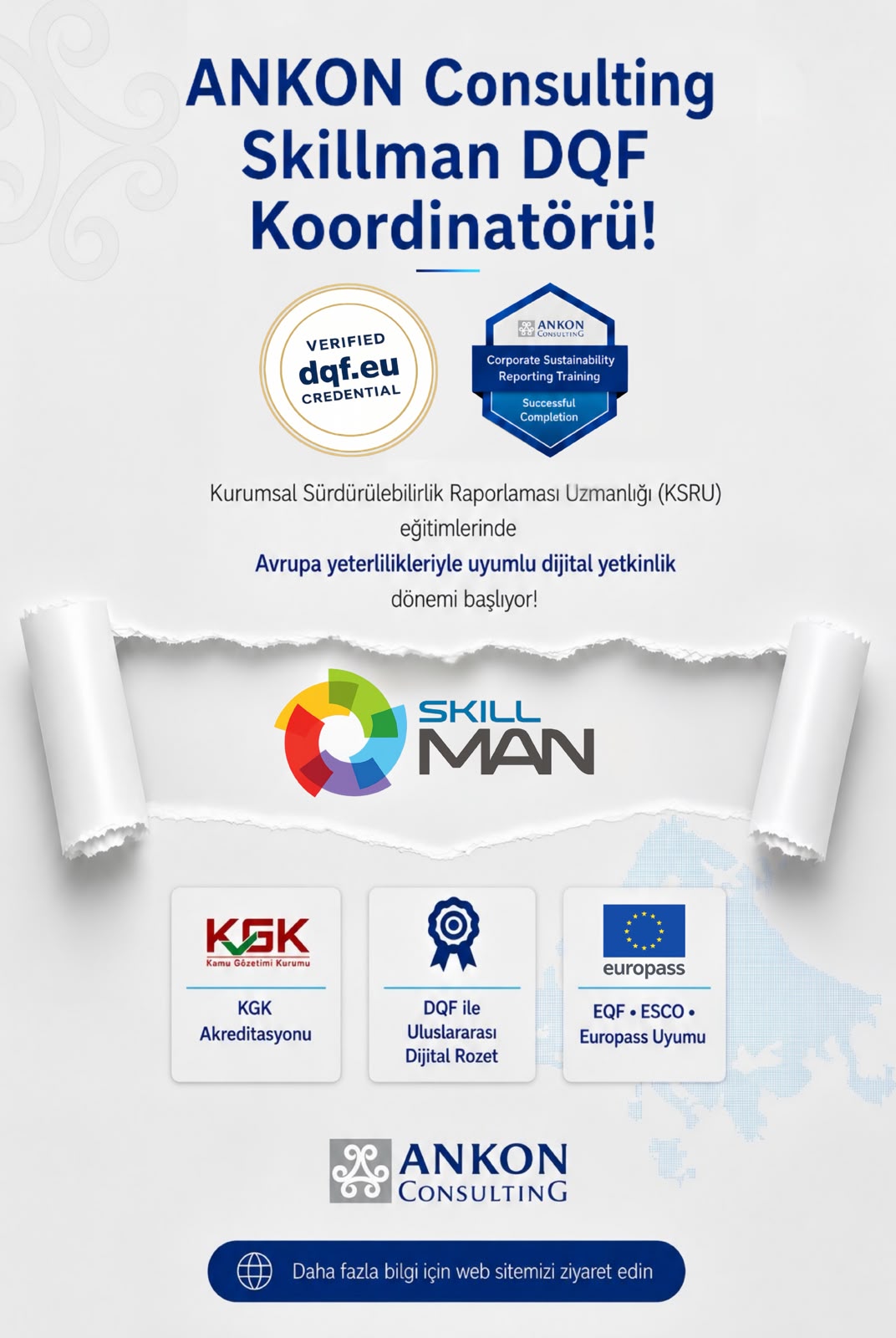
DQF Digital Badge System
DQF is a framework developed for the digital documentation, sharing and verification of learning achievements and competencies. It provides a smart certificate demonstrating that an individual has acquired specific knowledge, skills or competencies. DQF digital badges are micro-credentials that document specific learning outcomes and acquired competencies as well as participation in training.
DQF is an innovative approach to digital credentials developed in line with the European Union’s skills, vocational education and qualifications policies. Developed by the Skillman network, the system is methodologically and structurally aligned with key European Commission frameworks, including the EQF (European Qualifications Framework), ESCO (European Skills, Competences, Qualifications and Occupations) and Europass .
Skillman is a European multi-stakeholder network supported by the European Commission, particularly through Erasmus+. It connects training providers, public institutions and the private sector to support skills development and alignment.
Within this framework, DQF complements formal EU mechanisms by providing a practical digital competency credential infrastructure aligned with EU policies and supporting international recognition .
Competencies defined within the KSRU training programme are aligned with the EU’s ESCO (European Skills, Competences, Qualifications and Occupations) classification. This approach supports connections between acquired competencies and skills identified in the European labour market, as well as international recognition .
These competencies are matched to the criteria and learning outcomes specified in the badge, making them measurable and verifiable.
Digital badges issued under this system:
- Provide a digital statement of learning outcomes
- Are based on Open Badges standards and can be shared across platforms
- Are aligned with systems such as the European Qualifications Framework (EQF), ESCO and Europass
- Can be readily verified by institutions, employers and third parties
The DQF system is also supported by blockchain infrastructure (EBSI) to ensure credential security, immutability and cross-border validity.
The “alignment” section of the badge structure indicates that the relevant competencies are directly linked to:
- National and international standards
- Occupational qualification frameworks
- The learning outcomes of the training programme.
In line with the competencies defined for KSRU training, participants acquire knowledge, skills and competencies linked to the international ESCO skills framework in the following areas:

Promoting
sustainability

Managing financial risks

Developing problem-solving strategies

Assessing the impacts of climate change

Applying corporate social responsibility principles

Conducting risk analyses

Monitoring social impacts

Preparing risk reports

Managing project performance indicators
These achievements are mapped to learning outcomes within the digital badge infrastructure, making them verifiable, measurable and visible internationally.
The DQF digital badge approach used in KSRU training contributes to KGK’s sustainability reporting ecosystem in the following ways:
Supporting Practical Application of Standards
Promotes TSRS standards at both the theoretical and competency-based practical levels
Making Training Quality Measurable
Training results are defined through specific learning outcomes
Participants’ acquisition of competencies can be monitored
International Alignment and Recognition
Alignment with European frameworks such as EQF and ESCO increases the international visibility of training delivered in Türkiye
Verifiability and Trust
Employers and institutions can verify competencies directly through digital badges
Provides a transparent and reliable verification mechanism alongside the certificate system
Lifelong Learning and Micro-Credentials
Participants can accumulate competencies acquired through different training programmes
Supports continuing professional development
ANKON’s DQF-based digital badge system gives KSRU training a structure that is:
Competency-focused
Measurable
Internationally aligned
Verifiable .
For participants:
The digital badge system documents competencies in a digital, portable format, providing visibility on career platforms and international recognition. It offers individuals a competitive advantage in sustainability.
For employers:
It enables candidates’ competencies to be verified quickly and reliably, while providing access to standardised, comparable information.
This approach offers an innovative model demonstrating that sustainability reporting specialists, or “green-collar” professionals, have completed training and acquired competencies in accordance with defined standards .